Upright, Clumping or Spreading: Read a Plant’s Shape
Learn to read a plant’s mature growth shape and choose upright, clumping or spreading forms that fit the space and role in your planting plan.
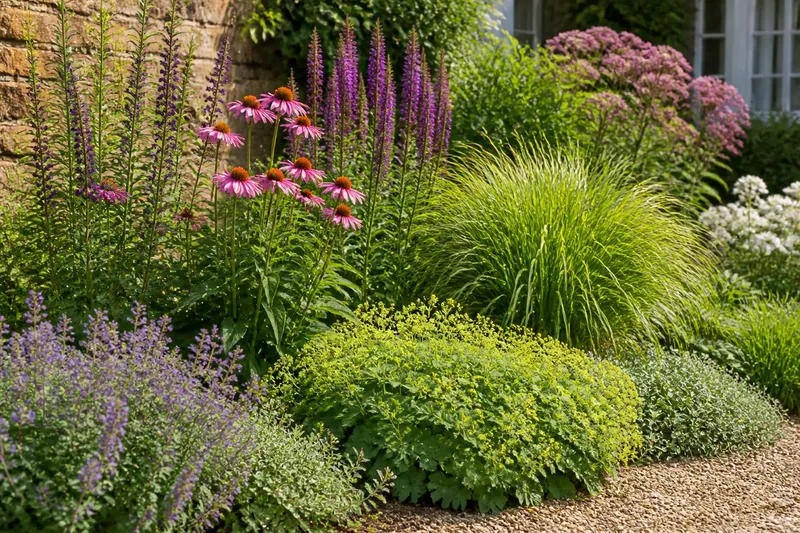
Choosing a plant by its flower photo can leave a surprise waiting in the border: a narrow-looking youngster may become a broad mound, or a tidy clump may send stems across its neighbours. To choose well, read a plant’s growth shape—upright, clumping or spreading—and match its mature form to the job and space you have.
These are useful broad descriptions, not rigid botanical boxes. A plant may be upright in its stems but widen with age, or spread slowly from a central crown. Look at the plant’s natural outline, how it adds new growth and how much room that growth needs, rather than relying on a single label.
Start with the job the plant needs to do
Before comparing varieties, decide what you want the plant to contribute. Is it a vertical accent, a substantial middle layer, a low edge, or a way to soften a gap? The answer points towards a form, even before you settle on flower colour.
- Choose upright growth when the planting needs height without much sideways spread, or when you want a clear vertical note among rounder forms.
- Choose a clump when you want a defined, substantial presence that can sit among neighbouring plants without roaming across the bed.
- Choose a spreading form when you want low growth to extend across open soil, soften an edge or link separate parts of a planting.
Then look at the space from more than one angle. A plant that seems to fit from the front may block a smaller neighbour from the side, and one that fills a bare-looking gap in spring may become crowded once surrounding plants are in leaf.
Upright plants suit height with a narrow footprint
Upright plants tend to send stems, leaves or flower spikes upwards, often creating a strong line. They can add height behind lower plants, draw the eye to a focal point or break up a sequence of low mounds. Their useful feature is not simply that they are tall; it is that their growth is more vertical than broad.
This form is often a good fit for a narrow border, a restrained planting beside a seat, or a spot where you want height without covering ground at the plant’s feet. A tall, slim form can also provide contrast beside rounded foliage. Check, however, whether the plant’s leaves fan out at the base or its flower stems lean beyond the upright outline.
Upright growth is less suitable if the plant’s eventual height would hide a window, overwhelm a short neighbour or crowd a narrow route. Consider the whole plant, not just its flowers: basal leaves may occupy more room than the stem above them. If a label gives a mature height and spread, use both figures to picture the outline; if it does not, seek a clear description from a reputable nursery or reference.
Spacing matters even for a narrow form. Several upright plants placed too close can merge into a dense wall, while a single specimen may look lost in a broad bed. Repeat the form where you want a rhythm, but leave enough room for the surrounding plants to remain visible.
Clumping plants suit a defined, self-contained presence
A clumping plant generally expands around a central crown, making a recognisable mound or tuft. The outline can be rounded, arching or fountain-like, but its growth remains centred rather than sending long runners across the bed. This makes clumps useful where you want substance and a legible boundary.
Use a clump as a middle layer between low edging plants and taller accents, or as a distinct island within a mixed border. Ornamental grasses and many perennial plants form clumps, though their mature width and foliage character differ greatly. A compact tuft can mark a small planting pocket; a broad mound needs space around its edge to keep its shape from swallowing nearby plants.
Clumping does not mean the plant will stay the same size. New growth can widen the crown over time, and neighbouring clumps may eventually touch. Allowing that contact can create a continuous-looking mass; leaving gaps gives each plant a clearer outline. Choose according to the visual effect you want, not a wish to keep every stem isolated.
This form is a sensible choice when you want a bed to look composed without asking one plant to cover the whole surface. It is less useful as a quick way to fill a large open patch if the clump grows slowly or remains small. In that situation, several appropriately spaced plants may make a more balanced planting than one oversized specimen.
Spreading plants suit ground coverage and soft edges
Spreading plants extend outwards, by creeping stems, runners, rhizomes or branches that root as they grow. Their outline tends to widen beyond the original planting point, so they can cover open soil, soften the lip of a bed or connect separate plants into a lower layer.
Choose a spreading form when the space is broad enough for it to expand and you welcome a connected, low-growing effect. It can be especially useful at the front of a border, where a looser edge looks more natural than a strict row of isolated crowns. But a spreader placed beside a small, slow-growing neighbour may soon compete for light and space.
Read the plant description for how it spreads, not only whether it does. A plant that creeps gently at the edge of a clump calls for a different decision from one described as vigorous or likely to colonise nearby ground. If the description is unclear, ask the nursery how the plant behaves in a garden bed. Local rules and the plant’s supplied care information matter where a species is known to spread beyond cultivated areas.
Think about boundaries before planting. A spreading plant beside a lawn, gravel strip or paving may cross into that surface, and a neighbouring bed may not be a meaningful barrier to underground growth. Where containment is important, choose a less assertive form or place the plant where its eventual reach is welcome.
Let the mature outline settle close decisions
Plant labels often show a young specimen or a close-up of flowers, neither of which tells the whole story. Look for mature height and spread, the expected habit, and whether the plant is described as upright, mounding, clump-forming, creeping or spreading. The details on the label, the manufacturer’s instructions where relevant, and local rules should guide decisions when they apply.
Imagine you have a narrow strip beside a low wall, with a small clump already planted near the front and a window behind it. An upright perennial with a modest spread could add height without taking over the foreground, while a broad spreader might spill across the clump and a large mound could crowd the wall. Sketching the likely mature outlines on paper makes the choice easier to judge before you plant.
For a mixed border, it can help to assign each plant a rough outline rather than draw every leaf. Mark an upright shape behind a clump and a low spreader at the front, then check whether one outline overlaps a space needed by another. This is not a demand for perfect spacing: plants change, and some overlap is part of a natural-looking planting. The sketch simply catches obvious clashes while you can still change the plan.
Also note when a plant reaches its fullest form. Some fill out quickly, while others take time to establish their mature outline. A new planting can look sparse before its clumps widen or a ground-covering plant advances; avoid crowding everything together just to disguise that early space unless you are prepared to thin plants later.
Which growth shape fits your planting situation?
Which plant shape suits a narrow border?
Start with upright plants if you need height but have little room to spare sideways. Check the mature spread and the width of the basal foliage, then use clumps to add body where the border has more depth.
Which shape works for a broad open patch?
A spreading plant can cover ground or link a low planting, provided its reach is welcome and manageable. If you want separate, clearly defined plants instead, use clumps and leave open space around each mature outline.
Can upright, clumping and spreading plants grow together?
Yes: the forms can make a layered planting, with upright growth behind, clumps in the middle and spreading plants towards the front. Check mature size and light needs as well as shape, so the taller forms do not shade out plants that need brighter conditions.
What if a plant’s shape is not clear from its label?
Search for the plant’s full name alongside terms such as “habit”, “mature spread” or “clump-forming”, or ask a knowledgeable nursery. A photo of an established plant can help, but look for its outline in context rather than judging from a close-up bloom.
Save effort for the choices that change the fit
You do not need to measure and map every leaf, or force a border into perfect symmetry. Exact spacing to a tiny fraction is not worth the effort when plants vary naturally and the garden will change through the seasons. Give the likely mature forms enough room, and pay particular attention to plants that may spread beyond their intended place.
When choosing by plant growth shape, the practical question is whether the form suits the space and the role you want it to play. An upright plant brings height, a clump holds a distinct place, and a spreader extends across open ground; the best fit is the one whose mature outline has somewhere useful to go.