A Garden Path Changes More Than the Route
Plan a garden path around daily journeys, useful stopping places and access to beds, so its position and surface make the whole garden easier to use.
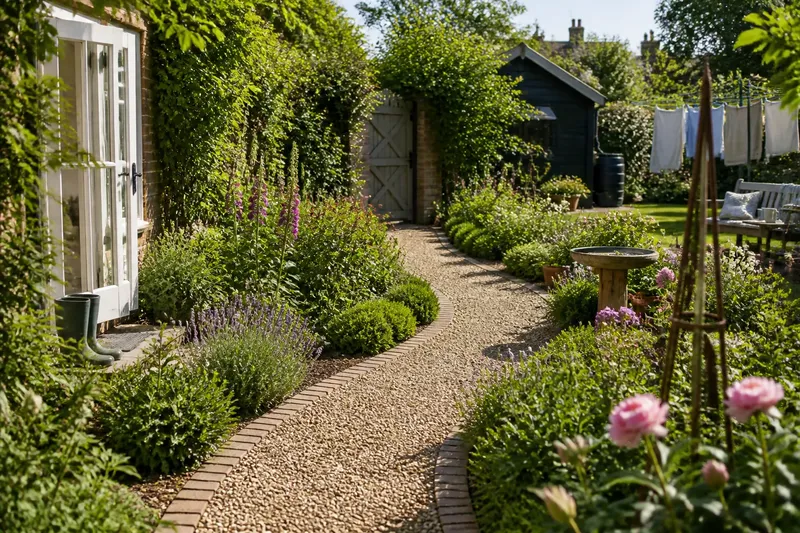
Where should a garden path go so it feels natural rather than cutting the garden in two? A garden path works best when it follows the journeys you actually make: from the back door to the washing line, from a gate to the shed, or out to a favourite seat with a mug in hand. Its position, width and surface shape where you pause, what you notice and which plants are easy to reach.
A path is more than a strip between beds. It can make a garden feel open and legible—or leave you stepping around muddy corners and squeezing past a wheelbarrow. Before choosing paving or gravel, look for the routes already written into the garden.
Start with the journeys that happen most often
It is tempting to draw the shortest line between two points, but that line may not serve the task. It might cross a planting area you want to enjoy, miss the door you use for garden tools, or make carrying a full watering can awkward.
Notice how you cross the garden during ordinary jobs. Track the routes from the house, gate, bin store, shed, tap and seating area. Look for detours too: perhaps you skirt a wet corner, step onto the lawn to reach a bed, or take the long way because a basket makes the path feel narrow.
Sketch the garden’s outline on paper and mark fixed features such as walls, doors, trees, steps and sheds. Use different lines for your regular routes, then note what you carry, where you stop and which places need to stay private or clear.
Say you often carry seed trays from a back door to a sunny bed, but the current route skirts the garden and ends at the wrong side. In this invented situation, you sketch a new line that reaches a stable standing place beside the bed, then walk it with the trays. The expected observable result is that you can set them down without squeezing between plants; if the approach still feels cramped, shift the line away from the bed edge.
Put the path where its turns and destinations work
If you keep stepping off a path, ask whether its position suits the task. A tight bend near a gate may make a wide turn with a wheelbarrow difficult. A route to a compost bay that stops short of its door can leave the final stretch muddy, however neat the rest of the line looks.
Draw the turn as well as the destination. Leave a clear approach where a gate or shed door swings and where you can pause to open it. If a route passes a bed, consider whether you need to reach it from one side or both; a small shift may make regular tending simpler.
Not every destination needs its own branch. Too many short spurs can split planting beds into awkward scraps and add edges to mow or maintain. Keep routes for regular journeys; an occasional destination might be reached across the lawn or by a temporary stepping stone instead.
Check the narrow points before settling the width
A path can seem roomy when empty and feel pinched with a watering can, a kneeling gardener or another person coming the other way. Look at the narrow points, not just the broadest stretch. A gatepost, low branch, projecting plant or tight turn may decide whether the whole route feels usable.
Mark the proposed edges with string, a garden hose or canes. Walk the route carrying the things you usually take outside, such as a trug, rake or hose nozzle. If a barrow must pass or two people need to meet, try that movement on the marked line before fixing the layout.
A landing near a doorway or work area may be more useful than making the entire path broad. It gives you somewhere to set down tools without turning the route into a terrace. A narrow garden may suit one clear line, while a larger garden can give a frequently used seat a broader approach and keep quieter paths modest.
Choose a surface for the route’s job
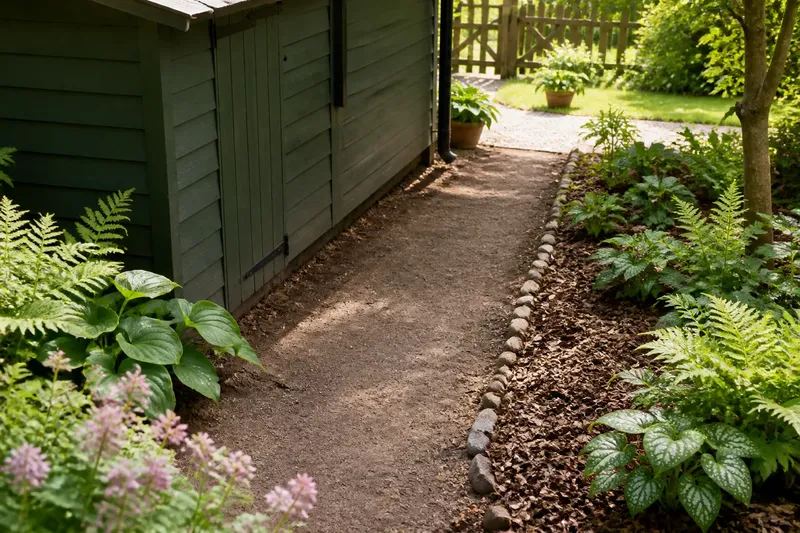
Surface affects sound, texture, upkeep and the sense of movement. Loose gravel brings a crunch and can suit an informal route, but it may shift under wheels or collect at thresholds. Brick and paving provide a firmer line; their pattern can draw the eye towards a doorway or soften the geometry of a straight bed. Bark and similar organic coverings can sit comfortably among informal planting, though they may need replenishing and may not suit a frequently used route.
Decide what the route must do before choosing its finish. Is it a main connection used in wet weather, a quiet path through planting or a short link to a seat? Consider whether you need a firm surface for a barrow, one that is easy to sweep near an entrance, or a visually quiet strip beside colourful borders. Follow the maker’s instructions and applicable local requirements when selecting and installing materials.
Try a temporary outline before buying anything. Use a hose to suggest a curve, string for a straight edge, or spare boards and flat stepping stones to test a firmer route. Walk the line during normal garden tasks and notice whether you follow it naturally, brush against planting or wish it continued farther.
It is not worth tracing every occasional wander or designing an elaborate decorative route before you know where it needs to go. A useful path can be modest. Its value comes from fitting the garden’s habits, not from looking complicated on paper.
Questions to settle before you fix a garden path?
Should a garden path be straight or curved?
A straight route makes a direct connection clear, especially between a door and a gate. A curve can soften a view or go around an existing feature, but it should still lead to somewhere you use rather than add a detour for its own sake.
How can I tell if a path is wide enough?
Mark the proposed edges and walk the route with the tools, basket or barrow you expect to carry. Pay close attention to turns, entrances and places where you may need to pass another person.
Does gravel suit every garden path?
Gravel can work well for an informal route, but loose material may be inconvenient where wheels, narrow thresholds or frequent sweeping matter. Compare it with firmer surfaces against the specific jobs the path must serve.
Can I plan a garden path before building it?
Yes. Mark the proposed line with a hose, string or temporary stones and use it during ordinary tasks. If you find a missed destination or awkward turn, adjust the route before committing to a permanent surface.
Use a ground-level check to make the final choice
Once you have marked the main journeys, draw a version that gives each route a clear start, destination and useful approach. Keep bed edges and fixed features visible so the path does not quietly take space from a place you want to plant or sit. Where routes overlap, give priority to regular access and work.
Return to the garden and inspect the line at ground level. Notice where rainwater runs, where roots or existing paving constrain the route, and whether a doorway, gate or shed needs room to open. These details can prompt a change of position before surface choice distracts from the layout.
- Observe whether the line reaches the actual destination; if it ends short, extend or reposition it, then walk the approach again.
- Observe whether you step off the route during a regular task; if you do, shift the line towards that task or choose a different route.
- Observe whether a gate or shed door swings into the path; if it does, move the route clear of the opening or create a more spacious landing.
- Observe whether a basket or watering can brushes the bed edge; if it does, widen that pinch point where possible or move the planting edge back.
- Observe whether a wheelbarrow turns comfortably; if it does not, soften or widen the turn, or choose a different approach to the destination.
- Observe whether loose gravel shifts at a threshold or beneath wheels; if it does, consider a firmer surface for that section or keep gravel for a quieter route.
- Observe whether rainwater crosses or collects on the proposed line; if it does, adjust the route or seek suitable advice on drainage before choosing the finish.
A garden path should make familiar journeys easy to read while leaving room for a slower wander, a pause beside a border or an unplanned turn. Plan its position around real use first: that simple garden path check can help the route join the garden together rather than merely cross it.