A First Garden Walk After the Leaves Fall
A first garden walk after the leaves fall reveals paths, borders and lasting structure, helping you read the garden’s winter shape and plan what to revisit.
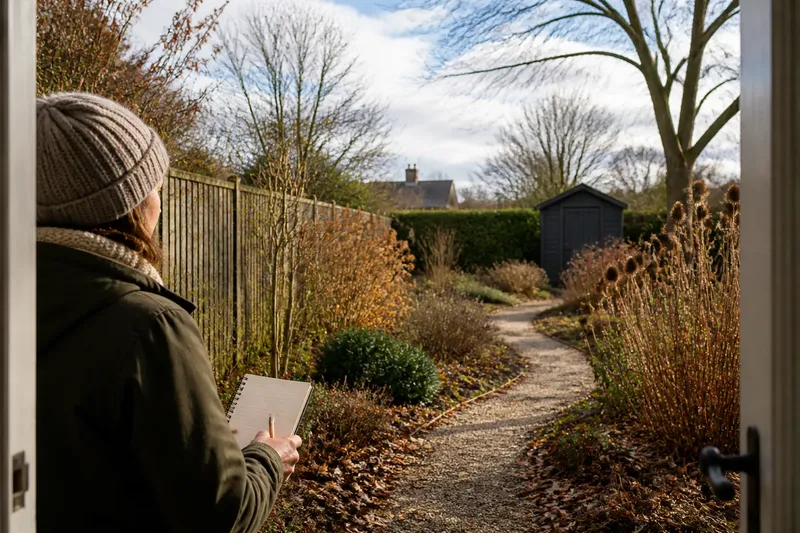
What can you see in your garden once fallen leaves open the view? A first garden walk after the leaves fall makes paths, borders and sturdy forms easier to read, so you can understand the garden’s winter shape before deciding what to do next.
Choose a dry spell, take a notebook and pencil, and leave the rake in the shed. Follow a familiar route, looking at how the space is arranged rather than turning the walk into a list of jobs.
Start with the view from the doorway
Stand where you usually enter the garden and look across its simpler palette. A fence, shed wall or distant hedge may now form the strongest line in the view. Notice what draws your eye and where it travels next.
Write a short note that names a visible feature and its position, such as “hazel stems beside the left fence” or “shed door at the end of the path”. This makes it easier to compare the same view later in the season. There is no need to make a change simply because a feature stands out.
Look at the open sky above the garden, too. Bare branches might frame a patch of cloud or reveal a neighbour’s roof that summer foliage screened. Those are seasonal features of the view, not automatic problems to fix.
Follow the path’s line and destination
Walk at an easy pace and notice where the route bends, meets another surface or ends. Tall summer plants may have made a path feel enclosed; after leaf fall, its direction and destination can be much clearer.
Check how the path stands out from its surroundings. Fallen leaves might soften a stone edge, while pale gravel may show more strongly against dark ground. These details describe the seasonal appearance of the route; they do not mean the path needs rebuilding or sweeping during your walk.
If the surface is slippery or the ground is soft, stay on a familiar, safe route and leave closer inspection for another day. There is no need to step into beds or reach under shrubs to understand the garden’s layout.
Trace the borders and their pauses
Follow a border from one end to the other. Its edge might be marked by a change in soil level, stones, a timber board or the meeting point between lawn and planting. Fallen leaves can soften that outline, while its curves and corners remain visible.
Notice where the pattern changes. A low evergreen shrub can create a pause between bare stems, and standing seed heads can mark a wider stretch of planting. These forms help explain how the border reads without requiring you to assign each plant a new purpose.
Say you have a narrow border along a fence, with taller stems gathered near one corner and low growth elsewhere. Note those positions, then compare them with the same view when new leaves appear. You will be able to see how returning growth changes the border’s outline before choosing whether any adjustment is needed.
Which winter details should you look for?
How can I spot the garden’s main structure?
Look across the view for walls, hedges, trees, sturdy shrubs and fixed edges. Notice which lines frame the space and which interrupt it; a strong feature is not, by itself, a reason to soften or remove it.
What should I notice along a garden path?
Look for bends, junctions, changes of surface and the point where the route seems to lead. These features show how the path reads when nearby plants no longer form leafy screens.
Should I move fallen leaves during the walk?
Keep the walk focused on what is already visible, and do not disturb leaf cover just to expose an edge. If leaves make a frequently used surface slippery, address that separate practical concern using sensible precautions and any relevant product instructions.
What is useful to record?
Choose a detail you can recognise again, such as a border curve, an unexpected view or seed heads against a fence. A brief note about its position is more useful than trying to catalogue every feature.
Keep the walk focused on the garden’s winter shape
Pause to notice wind moving through dry stems or a dark branch against a pale sky. These details can help you see the garden as it is now, without turning every observation into a task.
It is not worth the effort to name or record every twig, seed head and shifting shadow. A short note about a clear feature is easier to revisit than a complete inventory.
Before going inside, look once more from the doorway and add the viewpoint to your note. The phrase “first garden walk after the leaves fall” can be a useful reminder of when you saw the garden this way. A later look from the same spot will make seasonal changes easier to recognise.